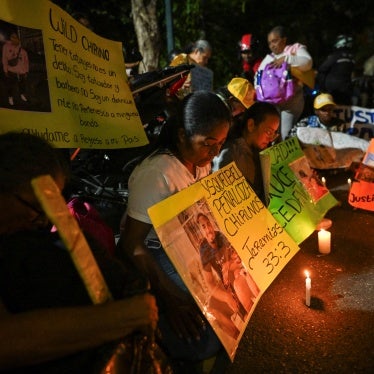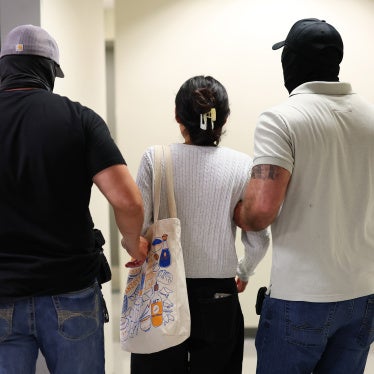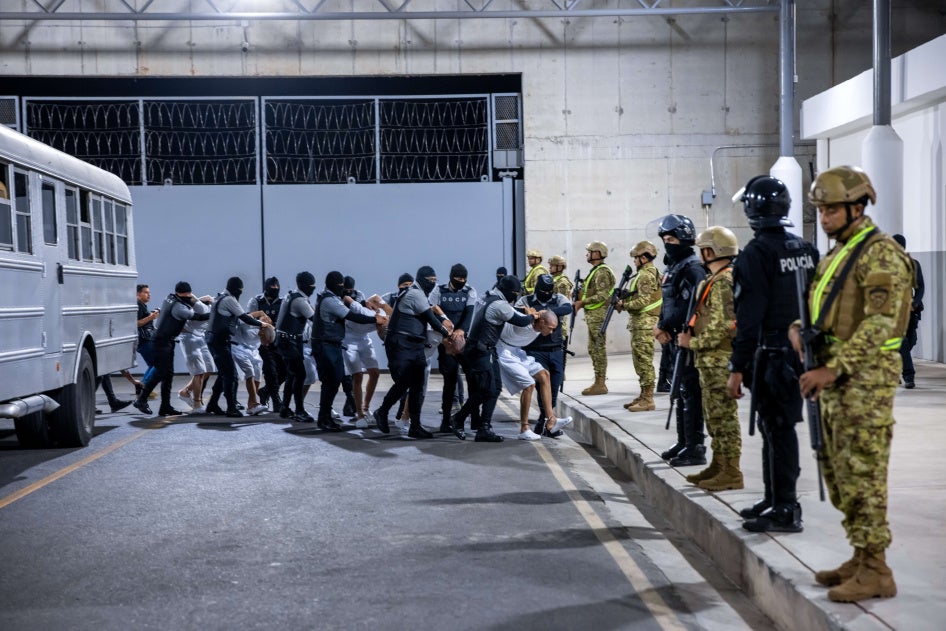
(Washington) – El Salvador is forcibly disappearing and arbitrarily detaining Salvadorans deported from the United States, Human Rights Watch said today, one year after some of the men were sent to El Salvador.
The detained people are among more than 9,000 Salvadorans deported by the United States since the start of 2025. Some of them were deported on March 15, 2025, alongside the Venezuelans who were tortured and, in some cases, sexually abused in the Center for Terrorism Confinement (Centro de Confinamiento del Terrorismo, CECOT) mega prison.
“Whatever the criminal history of these Salvadoran men, they have a right to due process, to be taken before a judge, and their relatives are entitled to know where they are being held and why,” said Juanita Goebertus, Americas director at Human Rights Watch. “Deportation cannot mean enforced disappearance.”
Human Rights Watch interviewed 20 relatives and lawyers of 11 Salvadorans who were deported from the United States between mid-March and mid-October 2025 and then immediately detained in El Salvador. Like most detainees in El Salvador, these men have not been allowed to communicate with their relatives or lawyers.
None of the relatives or lawyers have had any indication from the authorities that the men have been brought before a judge since their arrival. Some have not been informed of where their loved ones are held, or why. In five cases, relatives learned about deportees’ whereabouts only though litigation at the Inter-American Commission on Human Rights (IACHR).
The Trump administration has alleged that several of the Salvadorans are members of the MS-13 gang. The United States disclosed that one of them is César Humberto López Larios (“El Greñas”), a known MS-13 gang leader. Neither US nor Salvadoran authorities have provided evidence or information to substantiate the claim that any of the others are gang members.
Human Rights Watch analysis of Immigration and Customs Enforcement (ICE) data indicates that, of the at least 9,000 Salvadorans deported to El Salvador since January 2025, only 10.5 percent had a conviction in the United States for a violent or potentially violent crime. Relatives of ten of those detained said that they had served sentences in the United States: some for possession of drugs and two for violent crimes, including one for homicide and one for sexual assault.
Some of the people interviewed said their relatives had fled domestic or criminal violence, including recruitment-related threats and extortion by gangs in El Salvador. Some had apparently been living in the United States for several years.
On March 15, 2025, US authorities deported 23 Salvadorans to El Salvador, including Kilmar Ábrego García, whom the Trump administration said was deported due to an “administrative error.” On June 6, he was returned to the United States, following an order by a federal judge. Ábrego’s lawyers told US courts that he was physically abused in Salvadoran prisons. On December 11, a U.S. District Court in Maryland ordered his release from ICE custody.
On April 14, 2025, the White House published the names of 12 more deported Salvadorans, without specifying when they were removed. On July 17, 404 Media published a leaked list of Venezuelan and Salvadoran nationals deported to El Salvador. However, neither the US nor the Salvadoran government has confirmed the list’s authenticity.
Most relatives interviewed said they tried to locate their relatives through ICE’s Online Detainee Locator System but found no results. They said US officials then told them that their relatives had been deported to El Salvador.
All of the relatives Human Rights Watch interviewed said they had asked Salvadoran authorities about their loved ones’ whereabouts. Authorities refused to provide information, claiming they “lacked a legal mandate” or that they had no record of them.
Relatives of five deportees submitted a request to the IACHR. In October and December 2025, El Salvador informed the commission that four of them were being held at the Santa Ana prison, and one other at CECOT. The commission said that El Salvador should disclose the detainees’ legal status, end their incommunicado detention, and take steps to protect them.
In two additional cases, relatives believe their loved ones are being held at CECOT. In one other case, family members believe their relative is detained at Santa Ana prison because they identified him in photos and videos posted by El Salvador President Nayib Bukele. In the remaining three cases documented by Human Rights Watch, relatives have no indication of their family members’ whereabouts.
Salvadoran courts have also refused to provide information. Relatives and lawyers of five of the deportees said they filed habeas corpus petitions before the Constitutional Chamber of the Supreme Court, in May, August and October 2025. The court rejected one petition, claiming the facts presented were not sufficiently “precise.” It has not responded to the others.
Under international law, an enforced disappearance occurs when authorities deprive a person of their liberty and then refuse to disclose that person’s fate or whereabouts, placing them outside the protection of the law.
Salvadoran authorities have not clarified the legal basis for the deportees’ detention or whether they will be brought before a judge. In some cases, the Salvadoran government told the IACHR that it had asked the United States for information and that the men remain in the Salvadoran prison system “pending the decision of the sending State regarding their migratory and legal status.”
The sister of one of the deportees said that her 32-year-old brother migrated to the United States in 2022 because of police abuse. US authorities deported him on March 15, 2025. “I kept calling the migrant shelter in El Salvador, but they never gave me any information, so I filed a complaint with the Human Rights Ombudsperson’s Office,” she said. “An official told me that my brother was deported on March 15 [but] because of the state of emergency they would not provide any information.”
The mother of another deportee, who had lived in the United States for 11 years beginning at the age of 17, said that the last time she spoke with her son was on March 13, 2025, when he said he would shortly be deported to El Salvador. On March 15, when she tried to locate him using ICE’s online locator system, no results appeared.
“That same day I started looking for lawyers in El Salvador, but several told me they could not take those cases because they feared government reprisals,” she said. “I called several institutions, the Attorney General’s Office, the Ombudsperson’s Office, a migrant shelter, and government ministries in El Salvador, but they gave me no information. At the Ombudsperson’s Office, they told me that due to the state of emergency, they were not obligated to provide me with information. I feel abandoned.”
El Salvador’s state of emergency has been in place since March 2022, The government has used it to suspend, among others, the rights to be informed promptly of the grounds for arrest, to remain silent, to legal representation, and the requirement to present any detainee before a judge within 72 hours of arrest. Human Rights Watch has documented widespread human rights violations during the state of emergency.
“The desperation of families to find disappeared loved ones evokes the darkest days of dictatorships in Latin America,” Goebertus said. “The United States should stop casting people into the black hole of El Salvador’s prison system.”